
Magnesium and Menopause: What Does the Evidence Say?
Magnesium and Menopause
What Does the Evidence Say?
Magnesium is essential for normal muscle, nerve and bone function, but its role during menopause is often overstated online. This guide examines what is biologically plausible, what has actually been studied and where the evidence remains uncertain.
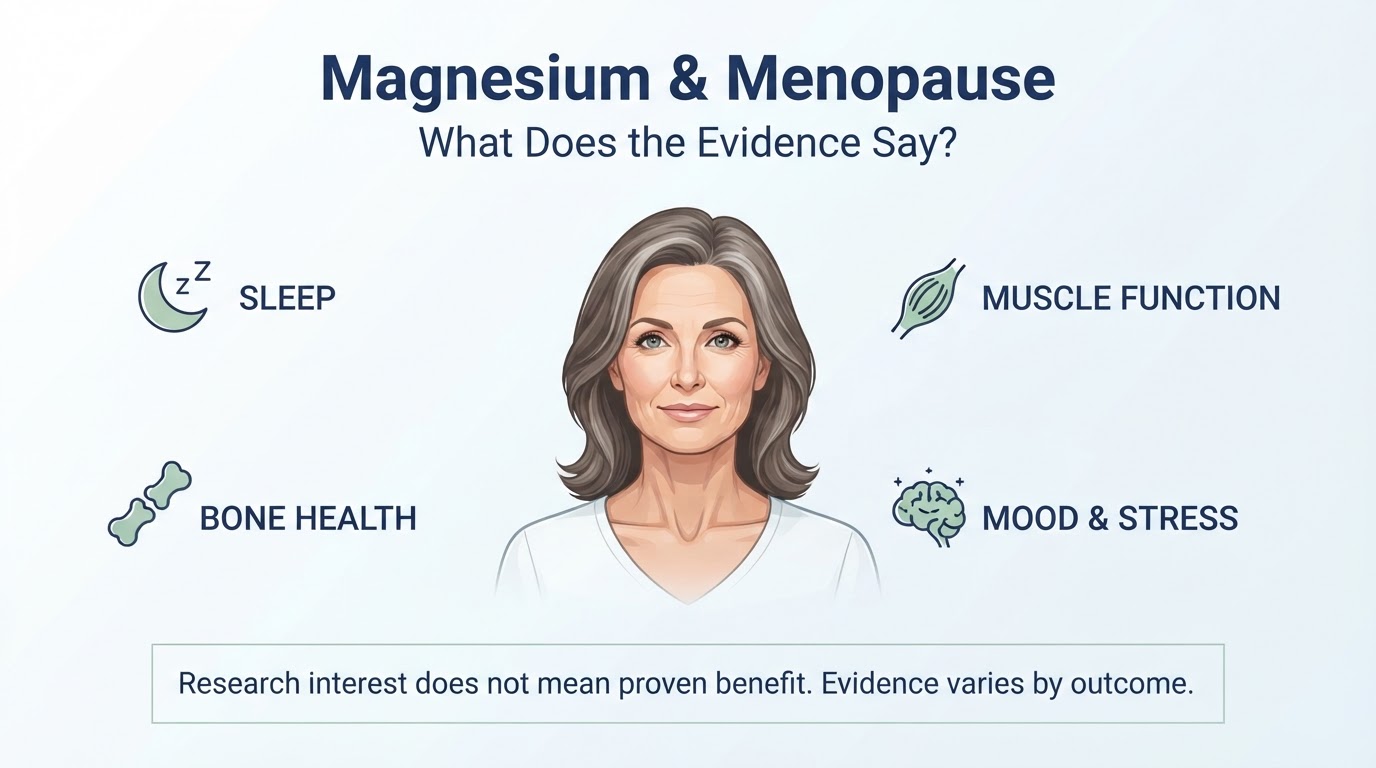
An essential physiological role does not automatically prove a therapeutic benefit.
Magnesium is involved in processes relevant to health during and after menopause. However, this is different from showing that magnesium supplementation reliably improves specific menopausal symptoms.
Why Magnesium Becomes Relevant During Menopause
Menopause is a normal biological transition, but declining estrogen levels and aging can influence several areas of health. Magnesium is relevant because it participates in physiological processes involving bone, muscle, nerves and energy metabolism.
Relevant physiology does not automatically mean effective treatment.
Magnesium may be biologically relevant to health concerns that become more important during and after menopause. Whether supplementation improves a specific symptom or clinical outcome is a separate scientific question.
Bone Loss Accelerates Around Menopause
Estrogen helps maintain bone. As estrogen levels decline, women can lose bone mass more rapidly, particularly during the years around menopause.
Magnesium is present in bone and participates in normal bone physiology, which makes adequate magnesium intake relevant to overall skeletal nutrition.
Maintaining Muscle Function Matters With Age
Aging is associated with changes in muscle mass, strength and physical function. Regular activity, adequate nutrition and overall health remain central to maintaining function.
Magnesium contributes to normal muscle contraction, relaxation and neuromuscular signaling.
Sleep Problems Are Common During the Menopausal Transition
Hot flashes, night sweats and other changes during perimenopause and menopause can disrupt sleep.
Magnesium participates in normal nervous-system function, which has prompted research into magnesium and sleep.
Mood Can Also Change During Midlife
Hormonal changes, sleep disruption, life circumstances and previous mental-health history can all influence mood during the menopausal transition.
Because magnesium is involved in nervous-system signaling, it is sometimes promoted for stress or mood support.
Creates physiological changes and new health priorities
Bone density, sleep, body composition and physical function can all become important areas of attention.
Participates in several relevant physiological systems
Magnesium is involved in bone, muscle, nerve and energy-related processes.
Biological relevance is not enough
Clinical trials are needed before claiming that supplementation improves a menopause-related outcome.
Magnesium and Bone Health After Menopause
Bone health becomes especially important after menopause because the decline in estrogen accelerates bone loss. Magnesium is relevant to skeletal physiology, but its role should be interpreted as part of a broader nutritional and clinical picture.
Magnesium is part of normal bone physiology.
A substantial proportion of the body's magnesium is stored in bone. Magnesium also participates in processes related to mineral metabolism and normal skeletal function.
Bone Mineral Structure
Magnesium is present in the skeleton and contributes to the mineral environment of bone.
Vitamin D Metabolism
Magnesium is involved in enzymatic processes related to vitamin D metabolism, which is relevant because vitamin D plays an important role in calcium balance and bone health.
Calcium Regulation
Magnesium participates in physiological processes that interact with calcium homeostasis and parathyroid hormone regulation.
Overall Nutritional Status
Bone health depends on more than one nutrient. Protein, calcium, vitamin D, magnesium, physical activity and hormonal status all contribute to the bigger picture.
Association is not the same as proven treatment.
Well established: magnesium is an essential mineral involved in normal bone and mineral metabolism.
Some studies have reported relationships between magnesium intake or status and bone mineral density.
Evidence is not strong enough to conclude that magnesium supplements alone prevent osteoporosis or fractures in postmenopausal women.
Magnesium is one piece of a much larger picture.
Important for bone mineralization.
Supports calcium absorption and bone metabolism.
Supports bone matrix and muscle health.
Provides mechanical stimulus for bone and muscle.
Estrogen decline affects the rate of bone loss.
Contributes to normal skeletal and mineral physiology.
Magnesium and Sleep During Menopause
Sleep problems are common during the menopausal transition. Magnesium is frequently promoted as a sleep supplement, but menopause-related sleep disruption has many possible causes — and the evidence for magnesium supplementation needs to be considered separately from its normal physiological role.
Why can sleep become more difficult during menopause?
Menopause does not create one single type of sleep problem. Several factors can overlap, which means the most appropriate approach depends partly on what is disrupting sleep.
Hot Flashes & Night Sweats
Vasomotor symptoms can cause nighttime awakenings and make it difficult to maintain uninterrupted sleep.
Hormonal Transition
Changes occurring during the menopausal transition can coincide with changes in sleep quality and sleep patterns.
Mood & Stress
Anxiety, mood changes, stress and major life circumstances can contribute to difficulty falling or staying asleep.
Other Sleep Disorders
Insomnia, sleep apnea, restless legs and other conditions may also contribute and should not automatically be attributed to menopause.
There is biological plausibility — but that is only the beginning.
Magnesium is required for normal nervous-system function and participates in neuronal signaling.
Magnesium participates in the physiological regulation of NMDA receptor activity, which is involved in excitatory neural signaling.
Magnesium contributes to normal muscle contraction and relaxation, another reason it is biologically relevant to nighttime physiology.
The evidence is still limited and inconsistent.
Studies of magnesium supplementation and sleep have produced some potentially positive findings, but the research base has important limitations. Studies differ in population, magnesium formulation, dose, duration and the way sleep is measured.
Magnesium is physiologically important.
It is an essential mineral required for normal nervous-system and muscle function.
Supplementation has been studied for sleep.
Some human studies suggest possible effects on selected sleep outcomes, particularly in certain populations, but results should not be generalized too broadly.
A treatment for menopausal insomnia.
Current evidence does not establish magnesium supplementation as a reliable treatment for sleep problems specifically caused by menopause.
What is actually disrupting your sleep?
A supplement cannot address every cause of poor sleep. Persistent nighttime hot flashes, chronic insomnia, loud snoring, breathing pauses, uncomfortable leg sensations or significant daytime sleepiness may require a more specific evaluation.
Want to understand the magnesium–sleep connection in more detail?
Our dedicated guide examines magnesium physiology, the limitations of current sleep research and what the evidence can — and cannot — tell us about supplementation.
Magnesium, Mood and Stress During Menopause
Mood changes can occur during the menopausal transition, but they are rarely explained by one nutrient or one hormone alone. Sleep, vasomotor symptoms, previous mental-health history, life stress and hormonal changes can all contribute.
Nervous-system involvement does not prove an antidepressant or anti-anxiety effect.
Magnesium is required for normal nerve signaling and many biochemical reactions. That makes it biologically relevant to brain function, but clinical benefit from supplementation must be demonstrated separately.
Why can mood change during midlife?
Hormonal Changes
Fluctuating and declining reproductive hormones may interact with brain systems involved in mood regulation during the menopausal transition.
Sleep Disruption
Repeated nighttime awakenings, insomnia, hot flashes and night sweats can affect daytime mood, concentration and emotional resilience.
Life Circumstances
Work, caregiving, relationships, health concerns and other midlife stressors can contribute independently of menopause.
Previous Mental-Health History
A previous history of depression or anxiety can influence risk during the menopausal transition and deserves appropriate clinical attention.
Magnesium has legitimate neurological functions.
Magnesium participates in normal neuronal signaling and membrane function.
Magnesium acts as a cofactor in hundreds of enzymatic reactions involved in normal cellular function.
Magnesium participates in energy-related biochemical reactions throughout the body, including nervous tissue.
The evidence is not strong enough for menopause-specific claims.
Magnesium supplementation has been investigated in relation to stress, anxiety and mood in several populations. However, study designs, populations and formulations vary, and menopause-specific evidence is limited.
Magnesium is required for normal nervous-system function.
Its physiological importance is well established.
Magnesium supplementation and stress or anxiety.
Some studies report possible benefits, but the overall evidence is heterogeneous and should be interpreted cautiously.
A treatment for menopause-related anxiety or depression.
Current evidence does not establish magnesium supplementation as a specific treatment for mood disorders during menopause.
Sleep, hot flashes and mood may influence one another.
Poor sleep can worsen mood and stress tolerance. Vasomotor symptoms can interrupt sleep, and anxiety can itself make falling asleep more difficult.
This means that identifying the main driver of symptoms can be more useful than assuming that all symptoms have a nutritional cause.
Magnesium and Muscle Function During and After Menopause
Maintaining muscle mass, strength and physical function becomes increasingly important during midlife and aging. Magnesium is involved in normal muscle physiology, but supplementation should not be confused with treatment for age-related muscle loss.
Normal muscle function depends on adequate magnesium.
Magnesium participates in neuromuscular signaling, muscle contraction, relaxation and energy-related biochemical reactions.
Where magnesium fits into normal muscle function
Magnesium interacts with calcium-dependent processes involved in normal muscle contraction.
Magnesium contributes to the regulation of neuromuscular activity and normal relaxation after contraction.
Magnesium is required for many enzymatic reactions involved in ATP production and cellular energy use.
Normal communication between nerves and muscle fibers depends on properly regulated electrolyte balance.
Muscle changes are influenced by much more than magnesium.
Muscle mass and strength can decline progressively with age, particularly when physical activity is low.
Menopause occurs during a period when hormonal and age-related changes may influence body composition and physical function.
Adequate dietary protein is important for maintaining and building muscle tissue.
Strength training provides one of the most important stimuli for preserving muscle mass and function.
Biological importance does not guarantee additional benefit from a supplement.
Magnesium is necessary for normal muscle function.
This physiological role is well established.
Magnesium status has been studied in relation to physical function.
Observational studies can identify relationships, but they do not prove that supplementation improves strength.
Magnesium supplements prevent age-related muscle loss.
Current evidence does not support describing magnesium as a stand-alone treatment for sarcopenia or menopause-related muscle changes.
Cramps do not automatically mean magnesium deficiency.
Muscle cramps can have many causes, including physical activity, dehydration, medications, neurological conditions, circulation and disturbances involving different electrolytes.
Magnesium deficiency is one possible factor in selected situations, but supplementation is not a universal solution for muscle cramps.
A broader strategy matters more than one mineral alone.
Supports muscle strength and functional capacity.
Provides amino acids needed for muscle protein synthesis.
Magnesium is one part of a balanced nutritional pattern.
Persistent weakness or functional decline deserves appropriate assessment.
Are Women Getting Enough Magnesium During Menopause?
Menopause itself does not automatically create a magnesium deficiency. The more useful question is whether usual dietary intake is adequate and whether other factors may influence magnesium status.
Adult women generally need about 310–320 mg of magnesium per day.
Recommended intake varies slightly by age and physiological status. For many adult women, the target is approximately 310 to 320 mg per day from food, beverages and supplements combined.
This is a recommended intake level, not a diagnostic threshold for deficiency.Dietary pattern matters more than menopause itself.
Low Intake of Whole Plant Foods
Diets containing few nuts, seeds, legumes, whole grains and leafy green vegetables may provide less magnesium.
Highly Refined Diets
Refining grains can reduce magnesium content compared with less processed whole-grain foods.
Reduced Food Variety
Restrictive or repetitive dietary patterns may make it more difficult to obtain adequate amounts of several micronutrients.
Other Health Factors
Gastrointestinal conditions, medications and increased losses can affect magnesium status independently of dietary intake.
Magnesium-rich foods can make a meaningful difference.
Concentrated source of magnesium and other nutrients.
Useful as snacks or additions to meals.
Provide magnesium together with fiber and plant protein.
Can contribute magnesium as part of a varied diet.
Generally provide more magnesium than highly refined grains.
One of several foods that can contribute to daily intake.
Eating less than recommended
Can increase the likelihood of inadequate magnesium status over time.
A medical and physiological state
Depends on intake, absorption, losses, health conditions and other factors.
Some women may have additional risk factors.
Women with gastrointestinal conditions associated with malabsorption or chronic diarrhea.
Women taking medications that can influence magnesium levels.
Women with persistently low intake of magnesium-rich foods.
Women with other health conditions that increase magnesium losses.
Should You Take Magnesium During Menopause?
There is no universal recommendation that every woman should take a magnesium supplement during menopause. The decision depends on dietary intake, individual health factors, medications and the reason for considering supplementation.
Menopause alone is not a reason to automatically start a magnesium supplement.
Magnesium is an essential mineral, but an essential nutrient is not the same thing as a supplement that everyone needs. Food intake, possible risk factors and individual circumstances should come first.
Start with three questions.
Are you regularly eating magnesium-rich foods?
Nuts, seeds, legumes, whole grains and leafy green vegetables can contribute substantially to daily magnesium intake.
Do you have factors that could affect magnesium status?
Certain gastrointestinal disorders, medications and other health conditions may influence absorption, losses or magnesium balance.
What are you expecting the supplement to do?
This matters. Correcting inadequate intake is different from expecting magnesium to treat hot flashes, insomnia, anxiety or other menopause-related symptoms.
Supplements can fill a gap, but they do not replace a balanced diet.
Usually the foundation
- Provide magnesium together with other nutrients
- Can contribute fiber, protein and healthy fats
- Support overall dietary quality
- Do not carry the same supplemental magnesium dose concerns
May be useful in selected situations
- Can help increase magnesium intake when diet falls short
- Provide a measurable amount per serving
- Different magnesium forms may have different characteristics
- Can cause side effects and interact with some medications
What magnesium supplementation can — and cannot — be assumed to do
Using supplementation to help meet magnesium needs when dietary intake is inadequate.
Discussing supplementation with a healthcare professional when individual risk factors are present.
Assuming magnesium will treat insomnia simply because sleep problems appeared during menopause.
Using magnesium as a replacement for appropriate evaluation of persistent or severe menopause-related symptoms.
Look beyond the word “magnesium” on the label.
Magnesium supplements are available in several chemical forms.
This tells you how much actual magnesium a serving provides.
More is not automatically better, particularly with supplemental magnesium.
Check the complete formulation rather than evaluating only the front of the label.
Glycinate, citrate, oxide and other forms — does the form of magnesium matter?
The next section looks at what those names mean and what you should actually compare when choosing a magnesium supplement.
Which Form of Magnesium Should You Choose?
Magnesium supplements come in different chemical forms, including glycinate, citrate, oxide and others. These forms differ in properties such as elemental magnesium content, gastrointestinal effects and absorption — but there is no single form that is automatically best for every woman during menopause.
“Magnesium” on the front of the bottle does not tell you the whole story.
The compound attached to magnesium affects the characteristics of the supplement. The label should also tell you how much elemental magnesium a serving actually provides.
What do the different names mean?
Magnesium Glycinate
Magnesium bound to the amino acid glycine. It is commonly marketed as a well-tolerated form and is widely used in supplements.
Magnesium Citrate
Magnesium combined with citric acid. It is a commonly available form and can have an osmotic effect in the gastrointestinal tract.
Magnesium Oxide
A form containing a relatively high proportion of elemental magnesium by weight, but the amount on the label should not be confused with the amount ultimately absorbed.
Other Forms
Magnesium is also sold as chloride, lactate, malate and other compounds. Marketing claims can differ considerably between forms, while comparative clinical evidence is often more limited.
Four details matter more than marketing language.
Check how many milligrams of actual magnesium are provided per serving, not simply the total weight of the magnesium compound.
Different magnesium salts and complexes have different chemical properties and gastrointestinal characteristics.
Some forms and doses are more likely than others to cause diarrhea, cramping or gastrointestinal discomfort.
Check other minerals, vitamins, additives and serving size rather than judging a product from one ingredient on the front label.
“Best magnesium for menopause”
A product may be marketed specifically for menopause, sleep, stress or muscle support, but those marketing categories do not establish that a particular magnesium form has been clinically proven superior for menopause.
Product positioning and clinical evidence are not the same thing.Magnesium Safety, Dosage and Who Should Be Careful
Magnesium supplements are widely available, but “natural” does not mean risk-free. Dose, kidney function, gastrointestinal tolerance and medication use all matter when deciding whether supplementation is appropriate.
This limit applies to supplemental magnesium — not magnesium naturally present in food.
For adults, the tolerable upper intake level is 350 mg per day from magnesium supplements and medications. This limit was established mainly because higher supplemental amounts can cause gastrointestinal adverse effects.
This is not the same as the recommended daily intake and does not include magnesium obtained naturally from food.What can happen when supplemental magnesium is not well tolerated?
One of the most common adverse effects of higher supplemental magnesium intake.
Some people experience nausea after taking magnesium supplements.
Gastrointestinal discomfort can occur, particularly at higher doses or with some formulations.
Magnesium can interfere with the absorption or handling of some medications.
Magnesium can bind with some tetracycline and quinolone antibiotics in the gastrointestinal tract and reduce their absorption.
Magnesium-containing supplements can reduce absorption of certain oral osteoporosis medications when taken too close together.
Some diuretics can increase magnesium losses, while others may reduce urinary magnesium excretion.
Long-term use of proton pump inhibitors can, in some people, be associated with low magnesium levels.
Medication use becomes increasingly relevant during midlife.
Some women in midlife may use medications for blood pressure, osteoporosis, reflux or other chronic conditions. This makes a medication review especially important before adding a magnesium supplement.
The correct timing between a medicine and magnesium can depend on the specific medication.
Professional guidance is especially useful in these situations.
You have kidney disease or impaired kidney function.
You regularly take prescription medications.
You have significant gastrointestinal disease.
You have multiple chronic medical conditions.
You are considering high supplemental doses or combining several magnesium-containing products.
You are trying to treat persistent menopause symptoms with supplements instead of seeking appropriate evaluation.
Count magnesium from all supplements you use.
Magnesium may appear in standalone supplements, multivitamins, electrolyte products, sleep formulas and other combination products. Looking at the total supplemental amount helps prevent accidental duplication.
Frequently Asked Questions About Magnesium and Menopause
Clear answers to common questions about magnesium, menopause symptoms, supplementation and safety.
Is magnesium good for menopause? +
Magnesium is an essential mineral involved in normal bone, muscle, nerve and energy-related functions. These physiological roles are relevant during midlife and after menopause.
However, this does not mean magnesium supplements have been proven to treat menopause itself or reliably improve all menopause-related symptoms.
Can magnesium help with sleep during menopause? +
Magnesium has been studied in relation to sleep, but the available evidence is limited and results vary between studies.
Menopause-related sleep problems can also be caused by hot flashes, night sweats, insomnia, sleep apnea, mood changes and other factors. Magnesium is not an established treatment for menopause-related sleep disturbance.
Read more about magnesium and sleep →Does magnesium help with hot flashes? +
Current evidence does not establish magnesium supplementation as a reliable treatment for menopausal hot flashes.
Hot flashes are vasomotor symptoms related to changes occurring during the menopausal transition and should not automatically be interpreted as a sign of magnesium deficiency.
Can magnesium help with muscle cramps during menopause? +
Magnesium deficiency can affect neuromuscular function, but muscle cramps have many possible causes.
Exercise, hydration, medications, circulation, neurological conditions and other electrolyte disturbances can all contribute. Cramps alone do not prove that additional magnesium is needed.
Does menopause cause magnesium deficiency? +
Menopause itself does not automatically cause magnesium deficiency.
Magnesium status depends on dietary intake, gastrointestinal absorption, kidney handling, medications, health conditions and other factors.
Read our magnesium deficiency guide →Can magnesium help with weight gain during menopause? +
Magnesium is involved in normal energy metabolism, but that does not mean magnesium supplements cause weight loss or prevent menopause-related weight gain.
Midlife weight changes can be influenced by aging, body composition, physical activity, diet, sleep and hormonal factors.
What is the best magnesium for menopause? +
No single magnesium form has been established as the best option for menopause.
Product choice should consider elemental magnesium, formulation, gastrointestinal tolerance, serving size, other ingredients and the reason supplementation is being considered.
Compare magnesium glycinate and citrate →Should every woman take magnesium after menopause? +
No. There is no universal recommendation that every woman should take a magnesium supplement simply because she has reached menopause.
Dietary intake, individual health status, medications and personal nutritional needs should be considered before supplementation.
How much magnesium do women need? +
Adult women generally require about 310 to 320 mg of magnesium per day, depending on age and physiological status.
This recommended intake includes magnesium from food, beverages and supplements combined. It should not be confused with the 350 mg upper limit that applies specifically to magnesium from supplements and medications in adults.
Can you take too much magnesium? +
Yes. Higher supplemental magnesium intake can cause diarrhea, nausea and abdominal cramping.
Excessive magnesium accumulation can become dangerous, particularly when kidney function is impaired.
References
Key authoritative and scientific sources used to support the information in this article.
NIH Office of Dietary Supplements
Magnesium: Fact Sheet for Health Professionals. Covers magnesium physiology, dietary sources, recommended intake, deficiency, supplements, safety and medication interactions.
View source →The Menopause Society
Evidence-based information on menopause, vasomotor symptoms, sleep, bone health and other health considerations during the menopausal transition.
View source →de Baaij et al. — Magnesium in Man
Comprehensive review of magnesium physiology, homeostasis, gastrointestinal absorption, kidney regulation and disorders of magnesium balance.
View study →Gröber et al. — Magnesium in Prevention and Therapy
Review discussing magnesium physiology, deficiency, supplementation and clinical considerations across several areas of health.
View study →Arab et al. — Magnesium and Sleep
Systematic review evaluating available literature on magnesium and sleep. Observational findings and intervention studies do not all point in the same direction.
View study →National Academies — Dietary Reference Intakes
Dietary Reference Intakes for calcium, phosphorus, magnesium, vitamin D and fluoride, including recommended intake levels and the tolerable upper intake level for supplemental magnesium.
View source →Magnesium Matters During Midlife — But Keep the Evidence in Perspective
Magnesium is essential for normal nerve and muscle function, energy metabolism and bone health. Those roles remain important during and after the menopausal transition.
But an essential physiological role does not automatically mean that taking more magnesium will treat menopause symptoms. Sleep problems, hot flashes, muscle complaints, mood changes and other midlife concerns can have multiple causes.
The most evidence-based approach is to first consider dietary intake, overall health, medications and individual risk factors — and then decide whether supplementation makes sense.
Nuts, seeds, legumes, whole grains and leafy greens can contribute meaningful amounts of magnesium.
Menopause symptoms should not automatically be interpreted as magnesium deficiency.
A supplement may help increase intake when dietary intake is inadequate or an individual need has been identified.
Learn how to evaluate a magnesium supplement first.
Our Magnesium Supplement Guide explains elemental magnesium, different forms, label reading, dosage considerations and what to compare before choosing a product.
Looking for a Magnesium Supplement?
If you have decided that a magnesium supplement fits your nutritional needs, one option you may want to evaluate is Magnesium Breakthrough by BiOptimizers.
Why we think it is worth evaluating
The formulation combines several forms of magnesium rather than relying on a single magnesium compound.
It allows you to evaluate the formulation, serving information and magnesium content before deciding whether it fits your needs.
We recommend evaluating it as a magnesium supplement, not as a treatment for hot flashes, insomnia or menopause itself.
Magnesium Breakthrough is a dietary supplement. Its inclusion here does not mean that it has been established as a treatment for menopause or menopause-related symptoms.
Check the formula, label and current offer directly from the manufacturer.
Review the product information and decide whether the formulation is appropriate for your individual needs.
Affiliate disclosure: This page contains an affiliate link. If you purchase through this link, MyVitalChoice may receive a commission at no additional cost to you. This does not affect our editorial approach or the price you pay.