
Magnesium for Sleep: What Does the Evidence Say?
Magnesium for Sleep
What Does the Evidence Say?
Magnesium is often promoted for better sleep, but the science is more nuanced. Here’s what research tells us about magnesium, sleep quality, deficiency and supplementation.
• Updated August 2026 • Evidence-Based Health GuideDoes Magnesium Actually Help You Sleep?
Possibly — but the evidence is not strong enough to say that magnesium reliably improves sleep for everyone.
Magnesium is an essential mineral involved in hundreds of biochemical reactions in the body, including processes related to normal nerve function, muscle function and energy metabolism.
Because magnesium participates in nervous-system function, researchers have investigated whether magnesium intake or supplementation may also influence sleep.
Some studies have reported improvements in certain sleep measures following magnesium supplementation, particularly in specific groups such as older adults. However, the available clinical evidence remains limited and results are not consistent across studies.
This means magnesium should not be viewed as a guaranteed treatment for insomnia or other sleep disorders.
Having adequate magnesium in the diet is important for normal physiological function. That does not automatically mean that taking extra magnesium will improve sleep when magnesium intake is already adequate.
How Could Magnesium Be Connected to Sleep?
Magnesium participates in several physiological processes involving the nervous system. These biological roles help explain why researchers have investigated magnesium in relation to sleep — but a plausible mechanism is not, by itself, proof that supplementation improves sleep.
Nerve Signaling
Magnesium contributes to normal nervous-system function and helps regulate processes involved in neuronal excitability and signal transmission.
NMDA Receptor Activity
Magnesium interacts with NMDA receptors, which participate in excitatory neurotransmission. Under normal physiological conditions, magnesium helps regulate ion flow through these receptor channels.
GABAergic Signaling
GABA is an important inhibitory neurotransmitter involved in reducing neuronal excitability. Magnesium has been investigated for its relationship with GABA-related signaling, one reason it has attracted interest in sleep research.
Muscle Function
Magnesium is required for normal muscle function and participates in the balance between muscle contraction and relaxation. This is a normal physiological role rather than evidence that magnesium acts as a sedative.
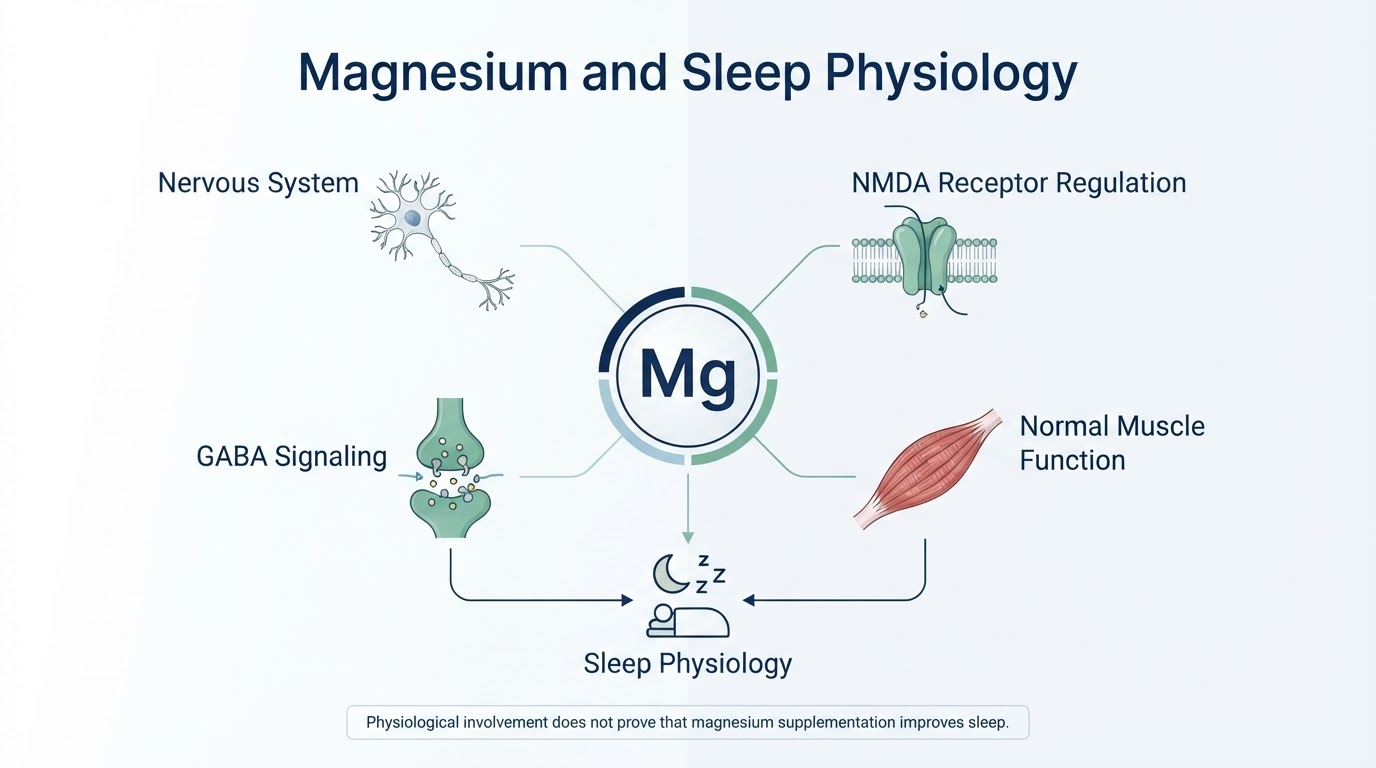
Biological mechanism ≠ proven sleep benefit
Understanding how magnesium participates in nervous-system function provides a biological rationale for studying sleep. However, it does not establish that taking additional magnesium will shorten the time needed to fall asleep, increase sleep duration or treat insomnia.
Those questions require controlled clinical studies measuring actual sleep outcomes.
What Does the Research Actually Show?
Research on magnesium supplementation and sleep has produced some encouraging findings, but the overall evidence remains limited. Study populations, magnesium forms, doses and methods of measuring sleep vary considerably.
Promising in some studies — not conclusive
Some clinical studies have reported improvements in individual sleep measures after magnesium supplementation. However, the number and quality of available trials are not sufficient to conclude that magnesium reliably improves sleep in the general population.
Older Adults
Several studies have focused on older adults, a population in which both sleep difficulties and inadequate magnesium intake may be more common.
Some trials have reported improvements in measures such as sleep efficiency, sleep time or the time required to fall asleep. However, these studies have generally involved relatively small numbers of participants.
Randomized Clinical Trials
Randomized controlled trials provide stronger evidence than observational studies, but relatively few have specifically tested magnesium supplementation as an intervention for sleep.
Results have not been sufficiently consistent to establish magnesium as a standard treatment for insomnia or other sleep disorders.
Observational Research
Population studies have examined associations between magnesium intake or magnesium status and sleep characteristics.
These studies can identify interesting relationships, but they cannot prove that magnesium itself caused differences in sleep.
Different Forms and Doses
Studies do not always use the same magnesium compound or dose. Differences in formulation, elemental magnesium intake, study duration and participant characteristics make direct comparisons difficult.
This is one reason results from one magnesium product should not automatically be generalized to every other formulation.
How strong is the evidence for magnesium supplements and sleep?
Based on the current body of clinical research, the evidence is best described as limited and not yet definitive. Larger, well-controlled trials are needed to determine who may benefit, which formulations are most appropriate and what outcomes can reasonably be expected.
Does the Type of Magnesium Matter for Sleep?
Magnesium supplements come in several chemical forms. These forms can differ in properties such as solubility, elemental magnesium content and gastrointestinal tolerance — but that does not mean one form has been clearly proven to be the best for sleep.
“Best absorbed” and “best for sleep” are not the same claim.
A magnesium form can have useful formulation or absorption characteristics without having strong clinical evidence showing that it produces better sleep outcomes than other forms.
Magnesium Glycinate
Magnesium glycinate is magnesium associated with glycine, an amino acid. It is commonly marketed for relaxation and nighttime use and is often selected because gastrointestinal tolerance may be an important consideration.
Magnesium Citrate
Magnesium citrate combines magnesium with citric acid. It is widely used in supplements and may have a greater stool-softening effect in some individuals, particularly as the amount consumed increases.
Magnesium L-Threonate
Magnesium L-threonate has received attention because of research concerning magnesium concentrations in the nervous system. It is frequently marketed for cognitive and neurological applications.
Magnesium Oxide
Magnesium oxide contains a relatively high proportion of elemental magnesium by weight, but its absorption characteristics differ from several more soluble magnesium salts.
Look at more than the magnesium form
Check how much actual magnesium the serving provides.
Compare how many capsules, tablets or scoops are required.
Different forms and doses can affect the gastrointestinal tract differently.
Check whether the formula contains additional active ingredients that may influence how you evaluate the product.
Who Might Be More Likely to Have Low Magnesium Intake?
Before asking whether a magnesium supplement could help, it is useful to consider the starting point. Some people may consume less magnesium than recommended, while certain health conditions or medications can also affect magnesium status.
Low dietary intake is not the same as magnesium deficiency.
Eating less magnesium than recommended does not automatically mean that someone has a clinical magnesium deficiency. Magnesium status is influenced by dietary intake, absorption, gastrointestinal and kidney function, medications and other individual factors.
People With Low Dietary Intake
Diets containing relatively few magnesium-rich foods may provide less magnesium than recommended.
Older Adults
Older adults may have lower dietary magnesium intake than younger adults. Age-related changes in gastrointestinal absorption and kidney handling of magnesium may also influence magnesium status.
Medication use and chronic health conditions can add further complexity.
Some Gastrointestinal Conditions
Conditions that cause chronic diarrhea, malabsorption or significant intestinal dysfunction can reduce magnesium absorption or increase magnesium losses.
In these situations, magnesium status should be considered in the broader clinical context.
People With Type 2 Diabetes
Magnesium status can be affected in some people with type 2 diabetes, particularly when increased urinary magnesium losses occur.
This does not mean everyone with diabetes should automatically take a magnesium supplement.
Long-Term Heavy Alcohol Use
Chronic heavy alcohol use can be associated with several factors that contribute to lower magnesium status, including inadequate intake, gastrointestinal losses and increased urinary losses.
Certain Medications
Some medications can influence magnesium levels. Examples include certain diuretics and prolonged use of proton pump inhibitors in particular circumstances.
Do not stop or change a prescribed medication because of concerns about magnesium without discussing it with a healthcare professional.
Your starting magnesium status may matter.
If magnesium intake is inadequate, correcting that inadequacy has a different nutritional rationale from taking additional magnesium when intake is already sufficient.
This is one reason supplement studies can be difficult to interpret: participants may begin with different diets, magnesium status, health conditions and sleep problems.
Magnesium Supplements: Safety, Side Effects & Interactions
Magnesium from food is generally safe for healthy people. Supplements are different: higher supplemental amounts can cause gastrointestinal effects, and magnesium can interact with certain medications.
Magnesium From Food
For healthy people, magnesium naturally present in food does not generally need to be restricted because the kidneys can eliminate excess amounts.
Magnesium From Supplements
Supplemental magnesium can produce adverse effects, particularly gastrointestinal symptoms, when intake becomes too high or the formulation is poorly tolerated.
What can happen if a supplement does not agree with you?
One of the best-known adverse effects of supplemental magnesium.
Some people experience nausea after taking magnesium supplements.
Gastrointestinal discomfort can occur, particularly with larger supplemental amounts.
This limit applies to supplemental magnesium — not magnesium naturally present in food.
For adults, the U.S. tolerable upper intake level for magnesium from dietary supplements and medications is 350 mg per day. This limit was established primarily because higher supplemental intakes can cause gastrointestinal adverse effects.
The upper limit is not the same as the recommended daily intake and does not include magnesium obtained naturally from foods.Magnesium can affect how some medications are absorbed.
The timing between a magnesium supplement and certain medicines may matter. Examples include:
Magnesium can bind with certain tetracycline and quinolone antibiotics in the gastrointestinal tract and reduce their absorption.
Magnesium-containing supplements can interfere with the absorption of some oral medications used for osteoporosis when taken too close together.
Certain diuretics can increase or decrease magnesium losses, depending on the specific medication.
Long-term use of proton pump inhibitors can, in some cases, be associated with low magnesium levels.
Consider speaking with a healthcare professional if...
You have kidney disease or impaired kidney function.
You regularly take prescription medications.
You have persistent gastrointestinal symptoms or a condition that affects nutrient absorption.
Your sleep problems are persistent, severe or affecting daytime functioning.
“Natural” does not mean risk-free. The appropriate magnesium amount, formulation and timing can depend on diet, health status, medications and individual tolerance.
Frequently Asked Questions About Magnesium and Sleep
Short answers to common questions about magnesium supplements, bedtime use and sleep.
Does magnesium make you sleepy? +
Magnesium is not a sedative in the conventional sense. It participates in normal nervous-system and muscle function, which provides a physiological reason to study its relationship with sleep.
Current evidence does not show that magnesium reliably makes every person sleepy after taking it.
How long does magnesium take to work for sleep? +
There is no scientifically established period such as 30 minutes, one hour or a specific number of days that applies to everyone.
Studies use different magnesium forms, doses, study periods and participant populations, making a universal timing claim inappropriate.
What is the best magnesium for sleep? +
No magnesium form has been conclusively established as the best option for sleep.
Glycinate is frequently marketed for nighttime use and may be selected when gastrointestinal tolerance is important, but claims that it is universally superior for sleep exceed the current comparative clinical evidence.
Is magnesium glycinate better for sleep than citrate? +
There is not enough comparative clinical evidence to conclude that magnesium glycinate produces better sleep outcomes than magnesium citrate.
Their gastrointestinal characteristics differ, so individual tolerance may influence which form someone prefers.
Should magnesium be taken every night? +
Magnesium should not automatically be taken every night simply because someone experiences poor sleep.
Whether supplementation is appropriate depends on dietary intake, dose, health status, medications, product directions and individual needs.
Can you take too much magnesium? +
Yes. High supplemental magnesium intake can cause diarrhea, nausea and abdominal cramping. Very high magnesium levels can become dangerous, particularly when kidney function is impaired.
The U.S. tolerable upper intake level for adults is 350 mg per day from magnesium supplements and medications. This limit does not include magnesium naturally present in food.
Can magnesium interact with sleep medications? +
Magnesium can interact with certain medications or alter their absorption. The specific concern depends on the medicine rather than on whether it is taken at bedtime.
If you use prescription sleep medication or other regular medicines, ask a pharmacist or healthcare professional before adding a magnesium supplement.
Can poor sleep mean that I am low in magnesium? +
Poor sleep alone does not diagnose low magnesium intake or magnesium deficiency.
Sleep problems can have many causes, including stress, sleep disorders, medications, medical conditions, environment and lifestyle factors.
Want the Complete Picture on Magnesium?
This article focused specifically on magnesium and sleep. For a broader overview of magnesium — including food sources, supplement forms, labels, safety and common questions — explore our complete guide.
Read the Complete Magnesium Guide →References
Key scientific and authoritative sources used to support the information in this article.
NIH Office of Dietary Supplements
Magnesium: Fact Sheet for Health Professionals. Comprehensive information on magnesium physiology, dietary sources, supplements, recommended intake, safety and medication interactions.
View source →Arab et al. — Systematic Review
The Role of Magnesium in Sleep Health: a Systematic Review of Available Literature. Observational research suggested associations between magnesium status and sleep measures, while randomized clinical trials showed uncertain results.
View study →Mah & Pitre — Systematic Review and Meta-Analysis
Oral magnesium supplementation for insomnia in older adults. The review identified three randomized controlled trials and concluded that the quality of evidence was limited.
View study →Abbasi et al. — Randomized Clinical Trial
Study examining magnesium supplementation in older adults with primary insomnia. Some sleep-related measures improved, although the study involved a relatively small and specific population.
View study →Zhang et al. — Observational Study
Research examining magnesium intake in relation to sleep duration and sleep quality. The findings illustrate an association but do not establish that magnesium supplementation causes better sleep.
View study →Hausenblas et al. — Randomized Controlled Trial
Study evaluating magnesium L-threonate in adults reporting sleep problems. The findings are relevant to emerging research but should not be generalized automatically to all magnesium formulations.
View study →Multi-form magnesium supplement
Considering a Magnesium Supplement?
Magnesium Breakthrough is a multi-form magnesium supplement from BiOptimizers. If you're comparing magnesium products, you can review the current formula, Supplement Facts, serving information and purchasing options on the official product page.
Affiliate disclosure: If you purchase through this link, MyVitalChoice may earn a commission at no additional cost to you.