
Magnesium Deficiency: Signs, Causes and Who May Be at Risk
Magnesium Deficiency
Signs, Causes and Who May Be at Risk
Magnesium is essential for normal nerve and muscle function, energy metabolism and many other physiological processes. But having a symptom sometimes associated with low magnesium does not mean you have a magnesium deficiency.
• Updated August 2026 • Evidence-Based Health GuideLow magnesium intake is not the same as magnesium deficiency.
Diet, absorption, gastrointestinal losses, kidney function, medications and other health factors can all influence magnesium status.
Symptoms alone cannot diagnose magnesium deficiency.
Fatigue, muscle symptoms and other complaints linked with magnesium can have many different causes. Proper evaluation requires clinical context rather than relying on a symptom list alone.
What Is Magnesium Deficiency?
Magnesium deficiency occurs when the body does not have enough magnesium to support normal physiological function. This is different from simply eating less magnesium than recommended on a particular day.
Low Dietary Intake
A person's diet may provide less magnesium than recommended. This can increase the likelihood of inadequate magnesium status over time, but dietary intake alone does not diagnose deficiency.
Low Magnesium Status
Magnesium status reflects more than diet. Absorption, gastrointestinal losses, kidney handling, medications and other health factors can all influence how much magnesium is available to the body.
Clinical Deficiency
A clinically significant deficiency can develop when magnesium intake or absorption is insufficient, losses are increased, or regulation is impaired enough to affect normal physiological function.
Magnesium is distributed throughout the body.
Most magnesium in the body is stored in bone and soft tissues, while only a small proportion circulates in the blood.
For that reason, assessing magnesium status is not always as simple as interpreting one symptom or one isolated laboratory value.
Several pathways can reduce magnesium availability.
Diets consistently low in magnesium-rich foods may contribute.
Certain gastrointestinal conditions can interfere with magnesium absorption.
Chronic diarrhea, urinary losses or other conditions may increase magnesium loss.
Some medications can alter magnesium absorption or excretion.
Possible Signs and Symptoms of Magnesium Deficiency
Magnesium deficiency can affect several physiological systems, but the signs and symptoms are not specific. Many of them can occur for reasons unrelated to magnesium.
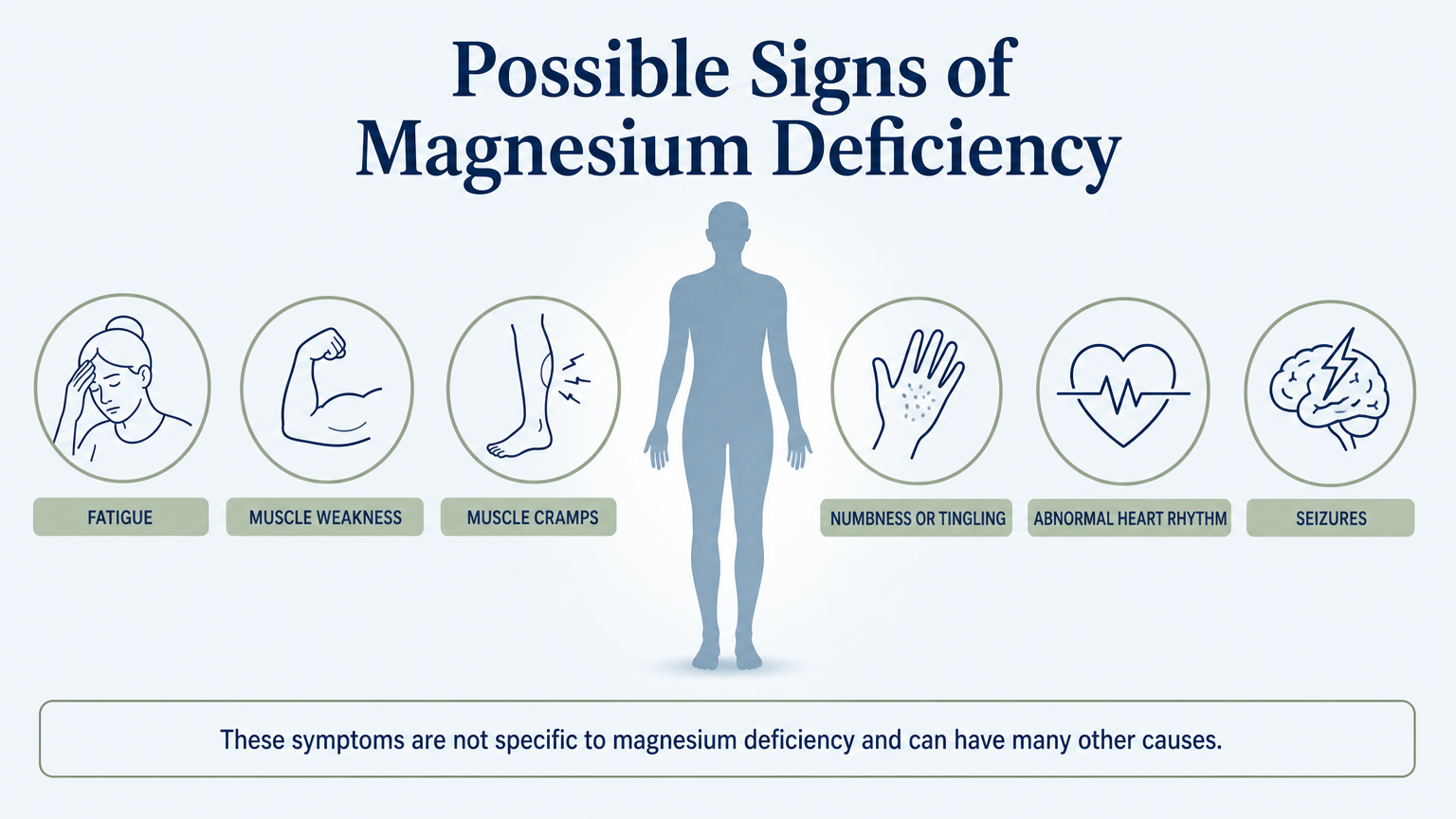
Fatigue
Fatigue can occur when magnesium status is significantly reduced, but it is one of the least specific symptoms. Sleep problems, anemia, thyroid disorders, infections, medications and many other factors can also cause fatigue.
Muscle Weakness
Magnesium participates in normal muscle function. More significant deficiency can be associated with weakness, but muscle weakness should not automatically be attributed to magnesium.
Muscle Cramps
Muscle cramps and spasms may occur with disturbances in electrolyte balance, including magnesium deficiency. However, cramps are common and can also be related to exercise, dehydration, medications, circulation or other medical conditions.
Numbness or Tingling
More pronounced magnesium deficiency can affect neuromuscular function and may be associated with numbness or tingling. Neurological symptoms have many other possible causes and deserve appropriate evaluation.
Abnormal Heart Rhythm
Severe electrolyte disturbances, including significant magnesium deficiency, can affect cardiac electrical activity. An irregular heartbeat should never be assumed to be caused by magnesium without medical assessment.
Seizures
Seizures are associated with severe magnesium deficiency rather than simple low dietary intake. They are a serious neurological symptom requiring urgent medical evaluation.
Mild inadequacy and severe deficiency are not the same thing.
A person whose diet provides somewhat less magnesium than recommended may have no obvious symptoms at all.
More serious neurological or cardiac manifestations are generally associated with more significant disturbances in magnesium status and should not be interpreted as common early warning signs.
What Causes Magnesium Deficiency?
Magnesium deficiency can develop when intake is too low, absorption is impaired, losses are increased or several of these factors occur together. In healthy people, short periods of lower intake do not necessarily lead to clinical deficiency.
Persistently Low Magnesium Intake
Diets that contain relatively few magnesium-rich foods can provide less magnesium than recommended. Important dietary sources include leafy green vegetables, legumes, nuts, seeds and whole grains.
Low intake can contribute to inadequate magnesium status, but it is not by itself proof of clinical deficiency.
Reduced Gastrointestinal Absorption
Magnesium must be absorbed through the gastrointestinal tract. Conditions that interfere with normal intestinal absorption can therefore make it more difficult to maintain adequate magnesium status.
Chronic malabsorption can matter even when magnesium is present in the diet.
Chronic Gastrointestinal Losses
Prolonged diarrhea and other significant gastrointestinal losses can increase magnesium loss from the body. When these losses continue, magnesium balance can become more difficult to maintain.
Persistent gastrointestinal symptoms should be evaluated for their underlying cause rather than managed only with supplements.
Increased Magnesium Loss Through the Kidneys
The kidneys play a central role in regulating magnesium balance. Certain health conditions and medications can increase urinary magnesium losses and contribute to lower magnesium status.
This is one reason magnesium status cannot be understood from diet alone.
Certain Medications
Some medications can influence magnesium absorption or excretion. Examples include certain diuretics, while prolonged use of proton pump inhibitors can be associated with low magnesium levels in some people.
Never stop or change a prescribed medication because of concerns about magnesium without speaking with a healthcare professional.
Sometimes there is more than one factor.
Magnesium status reflects the balance between intake, absorption and losses. A person may therefore have several contributing factors at the same time.
For example, lower dietary intake combined with gastrointestinal losses or medication-related changes may create a different situation from low dietary intake alone.
Who May Be at Higher Risk of Magnesium Deficiency?
Magnesium deficiency is more likely when intake, absorption or magnesium losses are affected over time. Certain health conditions, medications and life circumstances can increase risk.
People With Certain Gastrointestinal Conditions
Conditions associated with chronic diarrhea, malabsorption or significant intestinal dysfunction can reduce magnesium absorption or increase losses.
Some People With Type 2 Diabetes
Magnesium status may be lower in some people with type 2 diabetes, particularly when increased urinary magnesium losses occur.
People With Chronic Heavy Alcohol Use
Long-term heavy alcohol use can contribute to lower magnesium status through several mechanisms, including lower dietary intake, gastrointestinal losses and increased urinary losses.
Older Adults
Older adults may consume less magnesium and can experience age-related changes in gastrointestinal absorption and kidney handling of the mineral.
People Taking Certain Medications
Some medicines can alter magnesium absorption or excretion. Examples include certain diuretics, while prolonged proton pump inhibitor use can be associated with low magnesium in some individuals.
People With Persistently Low Dietary Intake
Diets consistently low in leafy greens, legumes, nuts, seeds and whole grains may provide less magnesium than recommended.
Risk factors can overlap.
Risk may be greater when several factors occur together. For example, an older adult with low dietary intake, gastrointestinal disease and medication-related magnesium losses may have a very different risk profile from a healthy person with only a temporarily low intake.
This is why magnesium status should be interpreted in context rather than through one symptom, one food choice or one risk factor.
Consider discussing magnesium status with a healthcare professional when...
You have a condition associated with chronic malabsorption or gastrointestinal losses.
You take medications known to influence magnesium levels.
You have persistent symptoms together with meaningful risk factors.
You are considering supplementation despite kidney disease or multiple medical conditions.
How Is Magnesium Deficiency Evaluated?
Magnesium status is evaluated using a combination of clinical context, medical history, dietary information and laboratory testing. No single symptom can reliably diagnose deficiency on its own.
Most of the body's magnesium is not circulating in the blood.
Magnesium is distributed mainly in bone and soft tissues, while only a small fraction is present in the bloodstream.
For that reason, blood magnesium can be useful clinically but may not always reflect total-body magnesium stores perfectly.
Medical History
A healthcare professional may consider gastrointestinal disease, kidney function, diabetes, alcohol use, previous electrolyte abnormalities and other medical factors.
Dietary Intake
Diet history can help identify whether magnesium-rich foods are regularly consumed, but dietary intake alone cannot confirm clinical deficiency.
Medication Review
Certain medications can influence magnesium absorption or excretion. Reviewing prescription and over-the-counter medicines can therefore be an important part of the assessment.
Laboratory Testing
Serum magnesium is commonly used in clinical practice. Depending on the situation, other laboratory findings and electrolyte levels may also help provide context.
Useful — but not a perfect measure of total-body magnesium
A serum magnesium test measures magnesium circulating in the blood. It is useful for identifying clear abnormalities and is widely used in clinical evaluation.
However, because only a small proportion of total-body magnesium is found in serum, a normal result does not always provide a complete picture of magnesium stores in every clinical situation.
Other electrolytes may also matter.
Magnesium disturbances can coexist with abnormalities in potassium balance.
Significant magnesium deficiency can also be associated with disturbances in calcium regulation.
Kidney function is important because the kidneys help regulate magnesium balance and excretion.
How to Get More Magnesium From Food
For many people, magnesium intake can be improved by regularly including magnesium-rich foods in the diet. Food also provides protein, fiber, vitamins and other minerals that supplements do not replace.
A supplement is not the only way to increase magnesium intake.
Dietary patterns that include nuts, seeds, legumes, whole grains and leafy green vegetables can make a meaningful contribution to daily magnesium intake.
Nuts and Seeds
Seeds and nuts are among the most concentrated food sources of magnesium and can be added to meals or snacks in relatively small portions.
Legumes
Beans, lentils and other legumes provide magnesium together with plant protein, fiber and other micronutrients.
Leafy Green Vegetables
Green leafy vegetables can contribute magnesium as part of a varied diet and also provide folate, vitamin K and other nutrients.
Whole Grains
Whole grains generally retain more magnesium than highly refined grains because more of the original grain structure remains.
Other Useful Sources
Magnesium is also present in a variety of other foods, so intake does not need to come from one specific ingredient.
The Overall Pattern Matters
Magnesium intake is usually more meaningful when viewed across the whole diet rather than focusing on one “superfood.”
Small choices can add up across the day.
Oats with chia seeds and almonds
Lentil or bean-based meal with leafy greens
Nuts, seeds or another magnesium-containing food
Whole grains with vegetables and a protein source
Provides magnesium as part of a broader nutrient package
Magnesium-rich foods also contribute fiber, protein, vitamins and other minerals.
Provide a concentrated and measurable amount
Supplements can be useful in selected situations but also require attention to dose, tolerance, interactions and health status.
When Might a Magnesium Supplement Be Considered?
Magnesium supplements can be useful in selected situations, but they are not automatically necessary whenever someone experiences fatigue, cramps or other nonspecific symptoms.
The first question is not “Which magnesium should I buy?”
A better starting point is whether supplementation is appropriate for your dietary intake, health status, medications and individual needs.
Dietary Intake Is Consistently Low
When a person's usual diet provides little magnesium and meaningful dietary improvement is difficult, supplementation may be one option to discuss.
A Healthcare Professional Recommends It
Supplementation may be recommended when clinical history, laboratory findings or another relevant factor indicates a need for additional magnesium.
There Are Ongoing Risk Factors
Certain gastrointestinal conditions, medication effects or other factors may make maintaining adequate magnesium status more difficult.
A Specific Nutritional Gap Has Been Identified
Supplements can sometimes help fill a nutritional gap when food intake alone does not provide enough magnesium for an individual's needs.
Look beyond the front label.
Compare the actual amount of magnesium provided per serving.
Different compounds can differ in solubility and gastrointestinal tolerance.
Check how many capsules, tablets or scoops make one full serving.
Review added ingredients, allergens and other active components.
Magnesium can interfere with the absorption of certain medicines.
Some formulations or doses can cause diarrhea or gastrointestinal discomfort.
A higher dose does not automatically make a better supplement.
Supplemental magnesium can cause diarrhea, nausea and abdominal cramping, especially at higher amounts or with formulations that are poorly tolerated.
Product choice should consider the amount needed rather than simply selecting the largest number on the label.
Supplementation can be appropriate for some people, but the decision should start with nutritional need and safety — not with symptoms alone or marketing claims.
Frequently Asked Questions About Magnesium Deficiency
Clear answers to common questions about low magnesium, symptoms, testing, diet and supplementation.
How do I know if I am deficient in magnesium? +
Symptoms alone cannot reliably determine whether you have magnesium deficiency. Fatigue, weakness, cramps and tingling can occur for many different reasons.
Evaluation may include your medical history, diet, medications, risk factors and laboratory testing when appropriate.
What are the most common signs of magnesium deficiency? +
Magnesium deficiency can be associated with symptoms such as fatigue, weakness, muscle cramps and neuromuscular changes.
More severe deficiency can be associated with numbness, tingling, abnormal heart rhythms or seizures. These findings are not specific to magnesium deficiency and require appropriate medical evaluation.
Can poor sleep mean I have magnesium deficiency? +
Poor sleep by itself is not evidence of magnesium deficiency. Sleep problems have many possible causes and cannot be used to diagnose magnesium status.
Research has examined the relationship between magnesium and sleep, but that is different from saying that insomnia indicates a magnesium deficiency.
Can muscle cramps mean I need magnesium? +
Not necessarily. Muscle cramps can occur for many reasons, including exercise, dehydration, medications, neurological conditions and disturbances involving different electrolytes.
Magnesium deficiency is one possible explanation in some situations, but cramps alone do not establish that additional magnesium is needed.
Can a blood test detect magnesium deficiency? +
Serum magnesium testing is commonly used clinically and can identify clear abnormalities in circulating magnesium.
However, only a small proportion of total-body magnesium is present in the blood. For that reason, laboratory results are interpreted together with the person's clinical situation rather than in isolation.
Can I get enough magnesium from food? +
Many people can obtain meaningful amounts of magnesium from a varied diet containing foods such as nuts, seeds, legumes, whole grains and leafy green vegetables.
Individual needs and circumstances differ, however, and some people may have conditions or other factors that affect magnesium intake, absorption or losses.
Should I take magnesium if I think my intake is low? +
Not automatically. Improving dietary sources may be a reasonable starting point for some people, while supplementation may be appropriate in other circumstances.
The decision should consider diet, health status, medications, kidney function and the amount of supplemental magnesium being considered.
Can you take too much magnesium? +
Yes. Excess magnesium from supplements and medications can cause diarrhea, nausea and abdominal cramping. Extremely high magnesium levels can be dangerous.
The risk of magnesium accumulation is particularly important when kidney function is impaired.
Want to Understand Magnesium Supplements Better?
Knowing the signs and risk factors for magnesium deficiency is only part of the picture. If you are considering supplementation, the next step is understanding what supplement labels actually mean and how different magnesium forms compare.
The Complete Magnesium Supplement Guide
Learn how to read magnesium supplement labels, understand elemental magnesium, compare common forms and evaluate dose, tolerance and other factors before choosing a product.
- What elemental magnesium means
- How magnesium forms differ
- What to look for on a supplement label
- Dose, tolerance and safety considerations
Magnesium Glycinate vs Citrate: What's the Difference?
If you are already comparing supplements, take a closer look at two widely used magnesium forms and the practical differences that may matter when reading product labels.
Signs, causes and risk factors
Forms, labels, dose and safety
Compare two common forms
References
Key authoritative and scientific sources used to support the information in this article.
NIH Office of Dietary Supplements
Magnesium: Fact Sheet for Health Professionals. Comprehensive information on magnesium physiology, dietary sources, recommended intake, deficiency, risk groups, supplementation, safety and medication interactions.
View source →Gröber et al. — Magnesium in Prevention and Therapy
Review discussing magnesium physiology, deficiency, clinical considerations and the relationship between magnesium status and several health conditions.
View study →de Baaij et al. — Magnesium in Man
Review of magnesium physiology, homeostasis and disorders of magnesium balance, including the role of the gastrointestinal tract and kidneys.
View study →Workinger et al. — Challenges in Magnesium Status Assessment
Review examining the difficulties involved in assessing magnesium status and the limitations of relying on a single biomarker or measurement.
View study →Costello et al. — Perspective on Magnesium Intake
Scientific perspective on magnesium intake, dietary adequacy and the challenges of interpreting magnesium status in populations.
View study →National Academies — Dietary Reference Intakes
Dietary Reference Intakes for calcium, phosphorus, magnesium, vitamin D and fluoride, including recommended intake levels and upper limits for supplemental magnesium.
View source →Multi-form magnesium supplement
One Magnesium Formula You Can Review
Magnesium Breakthrough is a multi-form magnesium supplement from BiOptimizers. If you are comparing magnesium products, you can review the current formula, Supplement Facts, serving size and purchasing information on the official product page.
A magnesium supplement should not be used as proof that you have magnesium deficiency, and this product is not being presented as a treatment for deficiency-related symptoms.
See which compounds are included.
Check the actual magnesium amount per serving.
Review how many capsules make one serving.
Check the complete Supplement Facts panel.
Product formula, price and availability can change. Confirm current information on the official website.