Hair serums can look surprisingly similar on the shelf, yet they may be designed for very different purposes — from smoothing the hair shaft to supporting a regular scalp-care routine.
If thinning hair is your main concern, knowing what to compare can help you look beyond packaging and marketing language and focus on the formula, intended use and practical details that matter.
Not every hair serum is designed for the same goal. Before comparing formulas, it helps to identify whether your main concern is thinning, breakage, dryness, scalp comfort or simply the appearance of finer hair.
This distinction matters because a product that improves shine or smoothness may make hair look healthier without necessarily addressing thinning at the scalp.
If you are noticing reduced density, a wider part or more visible scalp, look for products specifically intended for direct scalp application rather than only the hair lengths.
Breakage happens along the hair shaft. Conditioning serums, oils and protective products may help reduce friction and improve the appearance of damaged hair.
If dryness is the main concern, products designed to improve moisture, softness and manageability may be more relevant than a scalp-focused serum.
Fine hair describes the diameter of individual strands. It does not necessarily mean that hair is thinning or that hair density has decreased.
Someone can have naturally fine strands and still have normal hair density. Thinning, on the other hand, generally refers to a reduction in the amount or density of hair over time.
Understanding which situation applies to you can help prevent buying a product designed for the wrong purpose.
If thinning is your primary concern, focus first on products formulated for the scalp. Hair oils and finishing serums can still be useful for the lengths, but they serve a different purpose.
Products called “serums” can serve very different purposes. Some are formulated for the scalp, while others are designed mainly to smooth, condition or add shine to the hair shaft.
If thinning is your concern, this distinction is especially useful when comparing products.
A scalp serum is designed to be applied directly to the skin of the scalp rather than primarily to the hair lengths.
Hair oils are commonly used to condition the hair, reduce friction and improve softness or shine. Some oils may also be formulated for scalp application.
A finishing serum is generally used after washing or styling to improve the appearance and feel of the hair rather than as a targeted scalp product.
Check where the product is supposed to be applied. If a serum is intended only for the mid-lengths and ends, it is primarily a hair-shaft product — even if its packaging uses words associated with fuller or healthier-looking hair.
Once you know that you are looking for a scalp-focused serum, comparing products becomes easier. You do not need the longest ingredient list or the most dramatic claims — you need enough information to understand what the product contains, how it is intended to be used and whether it fits your routine.
Look for a product specifically designed to be applied to the scalp or areas where thinning is noticeable. This distinguishes it from serums intended mainly for smoothing the hair lengths.
You should be able to identify the ingredients in the formula rather than relying only on phrases such as “advanced complex” or “proprietary technology.”
Some formulas combine ingredients studied in hair-related research with ingredients that support hydration, texture, stability or scalp comfort. These functions should not be confused with one another.
Check whether the evidence refers to an individual ingredient, a specific ingredient complex or the finished serum itself. Those are different levels of evidence.
A product intended for frequent scalp use should also be comfortable to use. Botanical extracts, fragrances and other cosmetic ingredients may irritate sensitive scalps in some people.
Application frequency, drying time, texture and whether the serum needs to be rinsed can all influence how practical the product is for regular use.
A useful serum comparison goes beyond finding a familiar ingredient on the label. Look at the product's intended use, complete formulation, quality of supporting evidence, tolerability and how practical it will be to use consistently.
You do not need to memorize every ingredient on a serum label. Instead, it can be more useful to recognize a few common ingredient categories and understand why they may appear in a scalp formula.
Remember that the presence of an ingredient does not, by itself, establish how well the finished product will perform.
Rosemary preparations are frequently included in topical hair and scalp products and have also been investigated in hair-related research.
Look at the type of rosemary ingredient, the complete formulation and how the product is intended to be used.
Caffeine is commonly used in scalp products and has been studied in laboratory and topical hair research.
Distinguish research on caffeine itself from evidence involving the actual serum you are considering.
Peptides and peptide-based complexes appear in many modern cosmetic scalp formulations.
“Peptide” is a broad term. Look for information about the specific peptide or complex rather than relying on the word alone.
Ingredients such as ginseng, green tea, red clover and Centella asiatica may be included in multi-ingredient scalp formulas.
Botanical does not automatically mean effective or irritation-free. Consider the specific extract and the complete formulation.
Ingredients such as hyaluronic acid and other humectants can help support hydration and influence how a serum feels on the scalp.
Hydration can be useful for scalp care, but it should not be confused with evidence that an ingredient addresses the underlying cause of hair thinning.
Solvents, stabilizers, conditioning agents and delivery ingredients may not receive much attention in advertising, but they help determine the texture, stability and application characteristics of the finished serum.
Our ingredient guide takes a closer look at rosemary, caffeine, peptides, botanical extracts and the difference between ingredient-level research and finished-product evidence.
Do not choose a serum because it contains one fashionable ingredient. Look at the combination of ingredients, what each one contributes to the formula and how much evidence actually applies to the product you are evaluating.
Ingredients may get most of the attention, but a scalp serum also needs to be practical enough to use as directed. Texture, application method and frequency can make a significant difference to the experience of using a product regularly.
Before choosing a serum, check the instructions and think about how realistically the product will fit into your normal hair-care routine.
Lightweight formulas may be easier to distribute directly across the scalp without heavily coating the hair.
Droppers and targeted applicators can make it easier to place a serum directly onto specific areas of the scalp.
Some products are intended for daily use, while others may have different instructions. The recommended frequency should be clear before you buy.
Check whether the serum remains on the scalp or needs to be washed out after a certain period. This can affect when and how you use it.
Scalp, thinning areas, hair lengths or a combination?
Does the manufacturer provide a clear amount or application method?
Daily, several times per week or according to another schedule?
Leave it in, massage it into the scalp or rinse it out?
Hair-related changes are generally evaluated over time rather than after only a few applications. If a product is difficult, unpleasant or unrealistic to use according to its instructions, maintaining a consistent routine may become harder.
Pay attention to how your scalp responds. Stop using a cosmetic product if you develop significant irritation or an unexpected reaction, and seek professional advice when appropriate.
The “best” serum on paper may not be the best serum for your routine. Look for clear instructions, a practical application method and a formulation you can comfortably use as directed.
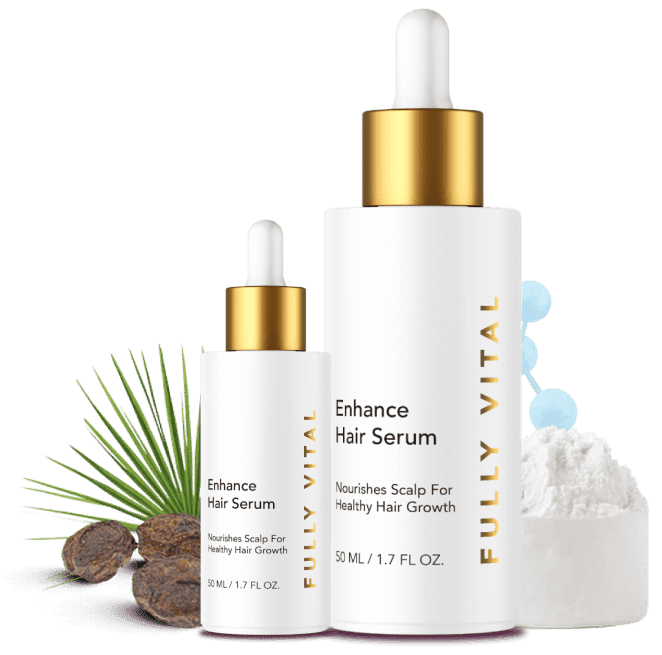
If you are looking for a scalp-focused, multi-ingredient serum, FullyVital is one option that fits several of the practical criteria discussed in this guide.
According to the manufacturer, the formula combines ingredients such as rosemary, caffeine, peptide-based ingredients and botanical extracts, and is designed for direct application to areas of the scalp where thinning is a concern.
Designed to be applied directly to the scalp rather than only to the hair lengths.
The manufacturer lists rosemary, caffeine, peptide-based ingredients and several botanical ingredients in the formula.
Current manufacturer instructions describe the serum as a once-daily scalp application.
The dropper format allows the serum to be placed directly on selected areas of the scalp.
Research involving ingredients such as rosemary or caffeine does not automatically demonstrate the effectiveness of the finished FullyVital formula. Product composition and usage information here are based on information provided by the manufacturer.
It is easy to be influenced by packaging, trending ingredients or dramatic before-and-after claims. A better comparison focuses on what the product actually is, what it contains and how well it matches your main concern.
Seeing rosemary, caffeine or peptides on the front of the bottle can be useful, but one highlighted ingredient does not tell you everything about the finished formula.
Botanical ingredients can be useful components of cosmetic formulas, but “natural” does not automatically mean more effective, safer or better tolerated.
Naturally fine strands and reduced hair density are not the same thing. A product for fuller-looking hair may improve appearance without addressing a scalp-related thinning concern.
Hair-related outcomes are generally evaluated over longer periods, and different products may have different types of supporting evidence.
A serum may have an appealing ingredient list but still be a poor match if its application method or frequency does not fit your routine.
Persistent, sudden or patchy hair loss may have causes that a cosmetic product cannot identify or address.
The most useful question is not “Which serum sounds the most impressive?” but rather “Which product best matches my concern, scalp, routine and expectations?”
Before choosing a serum for thinning hair, use this quick checklist to compare the product more objectively.
Check whether the instructions specifically direct you to apply the product to the scalp or thinning areas.
A transparent formula makes it easier to understand what you are actually buying.
Look beyond ingredient names and consider why they are included in the formula.
Check whether the supporting research applies to individual ingredients, a specific complex or the finished serum itself.
Consider the applicator, frequency of use and whether the product is leave-in or rinse-out.
A product that feels too heavy or inconvenient may be difficult to use consistently.
Be cautious with guarantees, instant-result language or claims that go far beyond the evidence being presented.
A cosmetic scalp serum may fit a thinning-focused routine, but it is not a substitute for investigating unexplained hair loss.
You do not need the serum with the most ingredients or the boldest claims. The better choice is the one whose purpose, formulation, instructions and evidence make sense for your needs and expectations.
Based on the current product information provided by the manufacturer, FullyVital fits several of the practical characteristics we would look for in a scalp-focused serum for thinning hair.
The product is intended to be applied directly to thinning areas of the scalp rather than used only on the hair lengths.
The manufacturer lists ingredients including rosemary, caffeine, peptide-based ingredients and several botanical components.
Current instructions describe a once-daily topical routine using a dropper to apply the serum to targeted scalp areas.
According to the product instructions, the serum can be applied and left on the scalp rather than requiring an immediate rinse.
A scalp-focused cosmetic serum for people comparing topical products for a thinning-hair routine.
Formula and usage descriptions above are based on current manufacturer information.A product matching these buying criteria does not guarantee a specific result. Individual ingredient research should not be treated as proof of the performance of a finished multi-ingredient serum. Hair thinning can also have many different causes.
This guide combines general hair and scalp-care information with independent scientific literature and clearly identified manufacturer-provided product information.
Studies involving an individual ingredient should not automatically be interpreted as evidence that every cosmetic product containing that ingredient will produce the same outcome.
Concentration, formulation, delivery system, application frequency, study population and duration can all affect how research findings translate to a finished product.
Stenn KS, Paus R. Controls of Hair Follicle Cycling. Physiological Reviews. 2001;81(1):449–494. DOI: 10.1152/physrev.2001.81.1.449
Herskovitz I, Tosti A. Female Pattern Hair Loss. International Journal of Endocrinology and Metabolism. 2013;11(4):e9860. DOI: 10.5812/ijem.9860
Panahi Y, Taghizadeh M, Marzony ET, Sahebkar A. Rosemary oil vs minoxidil 2% for the treatment of androgenetic alopecia: a randomized comparative trial. Skinmed. 2015;13(1):15–21. PMID: 25842469
Fischer TW, Hipler UC, Elsner P. Effect of caffeine and testosterone on the proliferation of human hair follicles in vitro. International Journal of Dermatology. 2007;46(1):27–35. DOI: 10.1111/j.1365-4632.2007.03119.x
Almohanna HM, Ahmed AA, Tsatalis JP, Tosti A. The Role of Vitamins and Minerals in Hair Loss: A Review. Dermatology and Therapy. 2019;9(1):51–70. DOI: 10.1007/s13555-018-0278-6
Malkud S. Telogen Effluvium: A Review. Journal of Clinical and Diagnostic Research. 2015;9(9):WE01–WE03. DOI: 10.7860/JCDR/2015/15219.6492
Descriptions of FullyVital's ingredients, application method, suggested frequency of use and other product characteristics are based on information currently provided by the manufacturer.
MyVitalChoice does not treat manufacturer claims as independent clinical evidence. Product information, pricing, availability and policies may change, so readers should review the current product website before purchasing.
This article is provided for general educational and informational purposes and is not intended to diagnose, treat, cure or prevent any medical condition.
Hair thinning or hair loss may be associated with many factors, including genetics, hormonal changes, nutritional deficiencies, medications, illness, stress and scalp conditions.
Consider speaking with a qualified healthcare professional or dermatologist if hair loss is sudden, patchy, persistent, rapidly worsening, associated with scalp symptoms or otherwise concerning.