Hair and scalp serums can contain dozens of different ingredients, from botanical extracts and peptides to caffeine, humectants and conditioning agents.
Understanding what these ingredients are — and what the available research actually tells us — can make it easier to compare formulas without relying only on marketing claims.
Two scalp serums can make similar claims while containing very different formulas. Looking at the ingredient list helps reveal what a product is actually made of — but understanding that list requires more than simply recognizing a few popular ingredients.
The role of an ingredient depends on factors such as its function, concentration, formulation and how the finished product is intended to be used.
Start by identifying what is actually present in the formula. Botanical extracts, peptides, caffeine and conditioning ingredients do not all serve the same purpose.
An ingredient does not work in isolation. The vehicle, combination of ingredients and overall formulation can influence how a topical product behaves on the scalp.
Some ingredients have human clinical research, while others are supported mainly by laboratory studies, preliminary evidence or cosmetic-use data.
Evidence for one ingredient does not automatically demonstrate that every finished serum containing it will produce the same result.
Seeing rosemary, caffeine or a peptide complex on a label can be useful, but the ingredient name alone does not tell you its concentration, how it has been formulated or whether the complete serum has been independently studied.
This distinction becomes especially important with hair products, where marketing language may move much faster than the scientific evidence.
Helps researchers explore biological mechanisms, but results observed in cells or isolated follicles do not necessarily predict what will happen when a person uses a cosmetic serum.
Clinical research can provide more directly relevant information, although study design, population, duration and the exact formulation still matter.
Research performed on the actual finished formula provides different information from research involving only one of its individual ingredients.
An interesting ingredient can make a formula worth examining, but it is not a guarantee of results. Ingredient research is most useful when it helps you understand a product rather than when it is used as proof for claims the research did not actually test.
Rosemary has become one of the most recognizable botanical ingredients in hair and scalp products. It is commonly used in oils, serums and scalp treatments, but the type of rosemary preparation and the way it is formulated can vary substantially.
Interest in rosemary for hair care increased in part because of a human comparative study evaluating rosemary oil in people with androgenetic alopecia. The findings are interesting, but they need to be interpreted in the context of the exact preparation and study design that were tested.
Rosemary-derived ingredients may be included in scalp products for botanical, conditioning or cosmetic purposes. Rosemary essential oil and rosemary extracts are not necessarily interchangeable, because their chemical composition and concentration can differ.
A randomized comparative trial published in 2015 evaluated rosemary oil and 2% minoxidil in participants with androgenetic alopecia over six months. Both groups showed an increase in hair count by the six-month assessment.
The study does not establish that every rosemary-containing serum will produce the same result. Different products may use different rosemary preparations, concentrations, vehicles and combinations of ingredients.
This study evaluated a specific rosemary-oil intervention. It should not be treated as evidence that any cosmetic serum containing rosemary is equivalent to the formulation used in the trial.
Rosemary has more human hair-related research than many fashionable cosmetic ingredients, which makes it scientifically interesting. But evidence for rosemary itself is not the same as evidence for every finished serum that contains it.
Caffeine is another ingredient frequently found in scalp serums, shampoos and leave-in hair products. Interest in topical caffeine comes partly from laboratory research exploring how it interacts with human hair follicles.
The available evidence is scientifically interesting, but it is important to separate laboratory findings from proof that every caffeine-containing cosmetic serum will improve hair density.
Caffeine is a biologically active compound that can interact with cells and tissues. Because topical products can place it directly on the scalp, researchers have explored whether caffeine may affect processes associated with the hair follicle.
Laboratory research using cultured human hair follicles has investigated caffeine exposure and follicle growth activity. Other studies have evaluated topical caffeine formulations in people with thinning hair or androgenetic alopecia.
Laboratory concentrations, delivery systems and experimental conditions may differ greatly from those found in a commercial serum. Findings from one formulation cannot automatically be generalized to another.
Laboratory studies can help explain why caffeine is scientifically interesting for topical hair research, but they do not establish the performance of every serum containing caffeine.
Caffeine has a plausible scientific basis for continued research in topical hair care, but evidence from laboratory studies or specific formulations should not be treated as proof that every caffeine-containing serum will produce visible hair growth.
Peptides are short chains of amino acids, but the word “peptide” covers a very broad group of ingredients. Different peptides may be included in scalp and hair formulas for different reasons, so identifying the specific peptide or peptide complex is important.
Some peptide-based ingredients are marketed for scalp support, follicle-related pathways or cosmetic improvement, but the strength of evidence can vary considerably from one ingredient to another.
Peptides are small chains made from amino acids. In cosmetic formulations, they may be used as signaling, conditioning or supportive ingredients depending on their structure and intended function.
Some peptide ingredients are designed to support the scalp environment, interact with biological pathways or improve the cosmetic condition of hair. These potential roles depend on the specific peptide being used.
Evidence involving one peptide cannot automatically be applied to another. A label that simply says “peptides” provides less useful information than one that identifies the actual peptide or proprietary complex.
The presence of peptides in a formula does not by itself establish that the product has been clinically proven to improve hair growth or density.
To interpret the claim properly, it helps to ask which peptide is present, what research exists for that ingredient, whether the concentration is disclosed and whether the finished serum itself has been evaluated.
This tells you something about the formula, but not whether the finished serum has demonstrated a particular clinical result.
This helps distinguish a meaningful formulation detail from a broad marketing term.
Peptides can be interesting components of a scalp serum, but the word “peptide” alone tells you very little. The specific ingredient, its formulation and the quality of the supporting evidence matter much more.
Rosemary, caffeine and peptides often receive the most attention, but scalp serums may contain many additional ingredients. Botanical extracts, humectants and conditioning agents can contribute to the overall formulation in different ways.
Some have been investigated for hair-related biological activity, while others primarily support hydration, scalp feel or the cosmetic condition of the hair. These are different functions — and they should not be interpreted as interchangeable evidence for hair growth.
Ginseng and its naturally occurring ginsenosides have been explored in laboratory and preclinical hair research. These findings have contributed to interest in ginseng as an ingredient in scalp-care formulas.
Green tea contains polyphenols, including catechins, that have been widely studied for biological activity. Hair-related research exists, but evidence supporting specific cosmetic scalp outcomes remains limited.
Red clover extracts appear in some proprietary hair-care complexes. When evaluating these formulas, it is useful to distinguish evidence for the botanical itself from studies performed on a specific multi-ingredient complex.
Centella asiatica is widely used in skin and cosmetic formulations and contains several biologically active compounds. Its presence in a scalp serum should be considered within the purpose and composition of the complete formula.
Hyaluronic acid is primarily valued for its water-binding properties. In scalp and hair products, it may help support hydration and product feel rather than acting as a treatment for the underlying causes of hair loss.
A serum also needs ingredients that help create its texture, stability and application properties. These may receive little attention in marketing, but they can influence how easily a formula spreads and feels on the scalp.
Plant-derived ingredients can be useful components of cosmetic formulations, but their origin does not determine whether they are effective or suitable for every scalp.
Botanical extracts and essential oils may also cause irritation or sensitivity in some people. Product tolerability depends on the complete formulation as well as individual sensitivity.
Ingredients studied specifically in relation to hair follicles, scalp biology or hair-related outcomes.
Components included to support the condition, hydration or cosmetic feel of the scalp.
Ingredients that help with texture, stability, delivery, preservation or the overall user experience.
A long ingredient list is not automatically better than a short one. What matters is why the ingredients are included, how they are formulated together and whether the claims being made are supported by appropriate evidence.
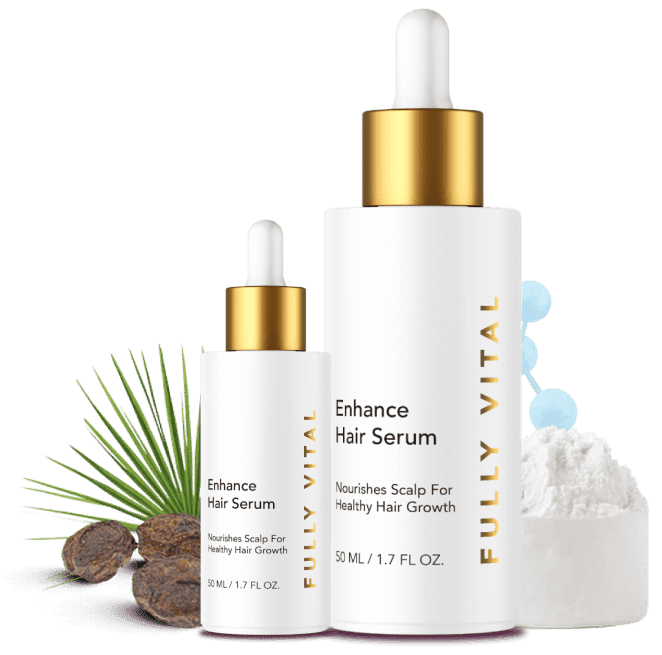
If you are comparing multi-ingredient scalp serums, FullyVital is one option worth examining because its formula combines several of the ingredient categories discussed in this guide.
According to the manufacturer, the formula includes ingredients such as rosemary, caffeine, peptides and botanical extracts, together with supporting cosmetic ingredients intended for regular scalp use.
A long ingredient list can look impressive, but more ingredients do not automatically mean a better serum. A useful comparison looks at how clearly the formula is described, what the product is intended to do and how realistic the claims are.
Instead of focusing only on one highlighted ingredient, consider the complete product and how well it fits your scalp-care routine.
Is the product designed for direct scalp application, hair lengths or both? A scalp serum for thinning hair should clearly explain where and how it is intended to be used.
Look beyond the front label. Check whether ingredients such as rosemary, caffeine or peptides appear in the actual ingredient list and whether the manufacturer explains their role.
A serum is more than its headline ingredient. Botanical extracts, humectants, solvents, conditioning agents and delivery ingredients all contribute to the finished formulation.
Ask whether claims are based on studies of the ingredient itself, a proprietary complex or the finished product. These are not equivalent forms of evidence.
Essential oils, botanical extracts and other active cosmetic ingredients may not suit every scalp. Pay attention to irritation, redness, itching or discomfort.
A formula may look appealing on paper, but regular use is easier when the product is practical, comfortable and compatible with your normal hair-care routine.
The best hair serum for thinning hair is not necessarily the one with the longest ingredient list or the strongest advertising. A more useful choice is one with a clear purpose, transparent formulation, realistic claims and an application routine you can follow consistently.
Compare formulas, not just buzzwords. Ingredient names are useful starting points, but the finished formulation, intended use, tolerability and quality of evidence provide much more meaningful information.
Scientific studies can help explain why certain ingredients are interesting, but not every type of research answers the same question. This distinction matters when evaluating hair serums.
A study may show a biological mechanism, a response in isolated hair follicles or an effect from a specific formulation. None of these findings automatically prove that every commercial serum containing that ingredient will produce the same outcome.
Laboratory research can help identify mechanisms and pathways that may be scientifically relevant.
Human studies can provide more directly relevant information than laboratory findings alone.
Research on a particular product or formulation can tell you about that exact intervention under the conditions studied.
Concentration, vehicle, stability and combination with other ingredients can differ between products.
A longer formula may be more complex, but complexity alone does not establish effectiveness.
Hair thinning can have multiple causes, including hormonal, nutritional, medical and genetic factors.
Explores how an ingredient may interact with cells, tissues or biological pathways.
Evaluate a specific ingredient or preparation under defined experimental conditions.
Examines outcomes in people and can provide more directly relevant evidence.
Tests the actual formula that consumers would use.
A common marketing shortcut is to take research on one ingredient and present it as though the entire finished product has demonstrated the same result.
A more careful approach is to separate what is known about the ingredient from what has actually been tested in the complete serum.
Ingredient evidence can support interest in a formula, but it does not replace evidence for the finished product. The closer the research is to the actual product, dose, application method and population, the more directly relevant it becomes.
If you are comparing scalp serums based on their ingredient profiles, FullyVital is one option to consider. According to the manufacturer, its formula combines several of the ingredient categories discussed throughout this guide.
The formula includes rosemary, caffeine, peptide-based ingredients and botanical extracts, according to the manufacturer.
The serum is intended for direct application to areas of the scalp where thinning is a concern.
Rather than judging it by one headline ingredient, consider the complete formula, intended use and how it fits your routine.
This guide was developed using independent scientific literature related to hair biology, female hair thinning and selected ingredients commonly found in topical hair and scalp products.
Controls of Hair Follicle Cycling. Physiological Reviews. 2001;81(1):449–494.
View publication →Female Pattern Hair Loss. International Journal of Endocrinology and Metabolism. 2013;11(4):e9860.
View publication →Rosemary oil vs minoxidil 2% for the treatment of androgenetic alopecia: a randomized comparative trial. Skinmed. 2015;13(1):15–21.
View on PubMed →Effect of caffeine and testosterone on the proliferation of human hair follicles in vitro. International Journal of Dermatology. 2007;46(1):27–35.
View publication →The Role of Vitamins and Minerals in Hair Loss: A Review. Dermatology and Therapy. 2019;9(1):51–70.
View publication →Telogen Effluvium: A Review. Journal of Clinical and Diagnostic Research. 2015;9(9):WE01–WE03.
View publication →Research involving an individual ingredient, isolated hair follicles or a specific experimental formulation should not be automatically extrapolated to every commercial product containing that ingredient.
Product performance can depend on concentration, formulation, delivery system, frequency of use and other factors. Unless a finished product itself has been appropriately studied, ingredient research should be interpreted as evidence about the ingredient — not as proof of the finished product's effectiveness.
The information on MyVitalChoice is provided for educational and informational purposes only and is not intended to diagnose, treat, cure or prevent any disease or medical condition.
Hair thinning and hair loss may be associated with many factors, including genetics, hormonal changes, nutritional deficiencies, medications, illness, stress and scalp conditions.
Consider speaking with a qualified healthcare professional or dermatologist if hair loss is sudden, severe, patchy, unexplained, progressively worsening or accompanied by scalp symptoms or other changes in your health.